
The poor are in debt, the middle saves, the rich are in debt?
The poor borrow, the middle class saves, and the rich borrow again, on purpose. If debt is bad, why does the person with the most money keep using it?
In short: whether a debt is good is not decided by “productive” or “consumptive”. It is decided by maths: a debt is good when it costs less than what your money earns safely while you keep it. That holds even for a phone on installments. In my Finance vs Cash tool, a genuine 0% plan on an $1,800 phone ends $44 ahead of paying cash, while a 24-month plan at about 9% ends $88 behind (all $ in this post are Australian dollars).
- If debt is bad, why do the rich borrow on purpose?
- What are the three ways to look at debt?
- How can a loan for a phone beat paying cash?
- Does the rule survive a real store offer?
- Credit card: my favourite type of debt
- So, is debt bad?
If debt is bad, why do the rich borrow on purpose?
Meet three people. The first stares at his phone and winces: $10K owing, and payday is still nine days away. The second hugs her piggy bank and smiles, because she has never owed anyone a cent. And the third, lounging on something that looks suspiciously like a throne, hands his credit card to a waiter and smiles too.
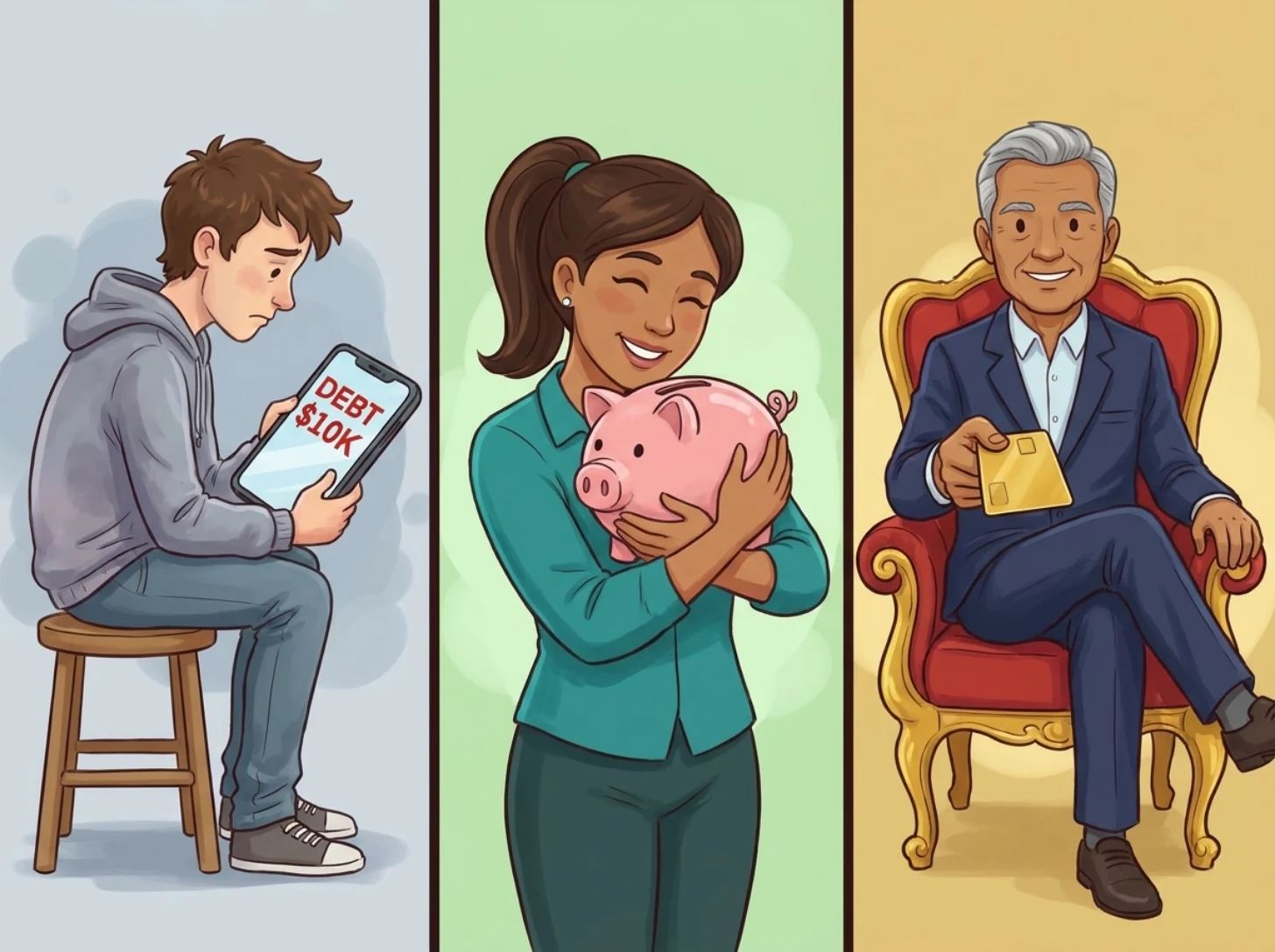
Two of the three are in debt, and only one of them is worried. If debt is bad, why is the richest person in the picture borrowing on purpose? And where do I sit? Somewhere between the second and the third: the middle class trying very hard to be rich, which so far mostly means I’ve picked up the third one’s habits before his bank balance.
Most of us grew up with one rule: debt is bad. Parents said it, grandparents said it louder, and the first person in the picture seems to prove it.
The poor borrow because they have to. When income doesn’t cover the month, the gap gets filled with whatever lends fastest, and the fastest money is the most expensive. In Australia, a payday loan (officially a “small amount credit contract”) can charge an establishment fee of up to 20% plus a monthly fee of up to 4%.1 Borrow $1,000 for three months and the fees alone are 20% × $1,000 = $200, plus 4% × $1,000 × 3 = $120. That’s $320 to borrow $1,000 for a season. Miss a buy now, pay later instalment on top of it and the late fees pile on. Then next month is short again, because this month’s repayment came out of it, and the loan rolls over.
The middle class can cover the month, so it steers clear. The second person pays cash, keeps a buffer and borrows only for things that feel respectable: a mortgage, maybe a business loan. “Good debt”, we call it.
The rich borrow on purpose. Not because they can’t pay. Because they can, and they’ve worked out that paying later is sometimes worth money. That is why I carry debt too. Not because I’m rich, sadly, but because I’m practising. 😂
What are the three ways to look at debt?
I see three levels of thinking about debt. Each one lets in a little more than the last.
Level 1: productive debt is good, consumptive debt is bad
This is the one most people know and accept. Borrow to buy something that earns (a business, a house you live in or rent out) and it’s good debt. Borrow to buy something that loses value (a TV, a holiday) and it’s bad debt.
It’s a decent rule, but even the poster child of good debt isn’t always good. In my rent vs buy post, buying a house won in Perth and renting won in Jakarta, with the same maths and different numbers. A mortgage is good when the house earns more than the loan costs, not because a house is “productive”.
Level 2: add the free instalments
Level 2 keeps productive debt and adds one kind of consumptive debt: the genuine 0% instalment. If you need a laptop anyway, splitting $1,800 into twelve payments of $150 at 0% is simply pressing pause on your spending. The money you haven’t paid yet stays in your savings account and keeps earning interest. That’s the time value of money, a.k.a. a dollar today is worth more than a dollar next year.
“But instalments just make you buy more stuff!” Fair worry. My answer: a car, a good laptop and a holiday are part of a good life too, not a moral failure. And the catch in level 2 matters: you already have the cash. You aren’t borrowing to afford the thing. You’re only choosing when the cash leaves.
Level 3: all debt is good
This is my own view, and yes, it’s deliberately provocative. At level 3 I stop caring whether an instalment is free or not, productive or consumptive. What matters is what the debt is worth in money terms, measured against what my cash would earn in the meantime. “Productive” and “consumptive” are labels. The rate is the verdict.
The sum behind it is in How can a loan for a phone beat paying cash?
How can a loan for a phone beat paying cash?
Say you need a new phone anyway. It’s pure consumption: no one is getting rich off a phone. Cash or instalments? It depends on three things:
- what your cash earns if you don’t spend it now
- the instalment’s interest and fees
- the scheme itself: how many months, and when the fees fall
Bring every payment back to today’s money and compare it with the cash price:
\[\text{Net benefit} = P - \sum_{t=1}^{n} \frac{c_t}{(1+r)^t}\]where \(P\) is the cash price, \(c_t\) is what you pay in month \(t\) (the instalment plus any fee due that month), \(r\) is what your cash earns per month, and \(n\) is the number of payments. A positive result means financing wins; a negative one means paying cash wins. Finance vs Cash does the same sum carried forward to the end of each plan, so its figures are in money at the end of the plan rather than today’s money.
Here is a $1,800 phone, with your cash sitting in a savings account at 4.5% a year (my assumption for a typical high-interest savings account in late 2026), computed in Finance vs Cash:2
| Plan | Monthly | All-in rate | vs paying cash |
|---|---|---|---|
| 12 × $150 at 0% | $150 | 0% | +$44 |
| 12 × $150 at 0%, plus a 3% fee ($54 upfront) | $150 | 5.81% | −$12 |
| 24 × $82 | $82 | 9.08% | −$88 |
| 36 × $57 | $57 | 9.07% | −$136 |
Three lessons hide in that table:
- The smallest monthly payment is the worst deal. $57 a month feels easiest and costs the most, because you pay interest for three years.
- A “0%” plan with a fee can lose. A $54 upfront fee turns 0% into 5.81%, which is more than the 4.5% the cash earns.
- A genuine 0% wins. Not by much, but it wins, because every dollar you haven’t paid yet keeps earning 4.5%.
Now, nobody is going to discount cash flows at the checkout. So here is the rule of thumb I use: the instalment’s all-in rate, fees included, must be lower than what your cash earns safely (a savings account, a term deposit). The phone plans in the table above agree. 0% is below 4.5%, so it wins. 5.81% is above 4.5%, so it loses. 9% loses by more.
Why “safely”? Shares might earn more, and on paper that could make even the 24-month plan look fine. But share returns are a bonus, not a promise, and a bonus is a poor thing to borrow against. Count only the rate you’re sure of. For anything messier (a cash discount, odd fees, different terms side by side), let the tool do the sum.
Does the rule survive a real store offer?
Here’s an offer where mental maths gives up. A $3,000 TV, and the store gives you three ways to pay:
- cash, with 5% off ($2,850)
- 12 months interest free, at the full $3,000
- 24 months interest free, at the full $3,000, with a $9.99 monthly account fee
Your savings earn 4.5%. In Finance vs Cash I entered the price, the cash I have, what that cash earns (the Risk-Free Rate) and each offer exactly as the store states it under Loan offers. The chart below shows each offer’s Net Benefit vs Cash over time.
Interactive chart: Finance vs Cash Scenario Explorer by Adjie Brotot Tools
Cash with the discount wins. The 12-month interest-free plan ends $83 behind it, and the 24-month “interest free” plan ends $268 behind, because the $9.99 fee gives it an all-in rate of 7.76% a year. Interest free, apparently, is not the same as free.
The twist is the discount. Take it away and the 12-month plan would win by $74, while the 24-month plan still loses by $104. The 5% off is a return on your cash too: $150 earned on the spot, which beats a year of 4.5% interest on money you’d be paying out month by month anyway. When a store offers a cash discount, it’s competing with “interest free”, and here it wins.
Credit card: my favourite type of debt
This one is personal, and a little teaser for a future post.
Credit card interest is terrifying, and the fear is earned. The average standard credit card in Australia charges about 21% a year (20.99% in 2026).3 Carry a balance and you’re paying more than almost any investment could earn back.
But here’s the thing: you pay zero interest if you clear the full statement balance by the due date, every month. Many Australian cards give you up to about 55 days interest free on a purchase.4 That’s weeks of free debt on everything you buy, while your cash sits in savings earning 4.5%. By the rule of thumb (borrow only when the all-in rate is below what your cash earns safely), 0% beats 4.5% every single time.
Then there’s the “return”: points. They can be swapped for plenty of things, but the most valuable use, for most people I know, is airline miles redeemed for premium cabins. How I earn and spend them deserves its own post.

One fair warning: this only works if you never carry a balance. Roll it over once and your favourite debt becomes the 21% kind.
So, is debt bad?
Back to the three people. The difference between them isn’t whether they borrow: two of the three do. It’s what the debt costs against what their money earns. The first borrows at a price far above anything his money could ever earn. The third borrows at 0%, or below what his money earns, and keeps his money working the whole time. The second, bless her, is leaving a little on the table out of caution, which is the most forgivable mistake of the three.
So yes, I’ll stand by the provocation: all debt is good. Its honest meaning is narrower than it sounds. The label doesn’t decide, the rate does. And I’ll concede the obvious: a debt that costs more than your cash earns is bad, whatever it’s called. A payday loan, a pricey buy now, pay later plan and a carried credit card balance all fail the test, and no amount of clever thinking rescues them.
Debt is bad when it costs more than your money earns, and good when your money earns more than it costs.
One small thing to try: before you sign your next instalment plan, compare its all-in rate with what your cash earns safely. If the plan has fees, a cash discount or a term you can’t eyeball, run it through Finance vs Cash first. (Not financial advice, just maths.)
-
ASIC Moneysmart, Payday loans: small amount credit contracts can charge a one-off establishment fee of up to 20% of the amount borrowed and a monthly account-keeping fee of up to 4%. ↩
-
All worked figures in this post (the phone plans and the TV offer) were computed in Finance vs Cash, Adjie Brotools, October 2026. The 4.5% savings rate is my assumption for a typical savings account in late 2026. ↩
-
Mozo, Credit cards, citing Reserve Bank of Australia data: average standard credit card purchase rate of 20.99% a year, 2026. ↩
-
ASIC Moneysmart, Credit cards; interest-free periods of up to about 55 days are typical issuer terms. ↩